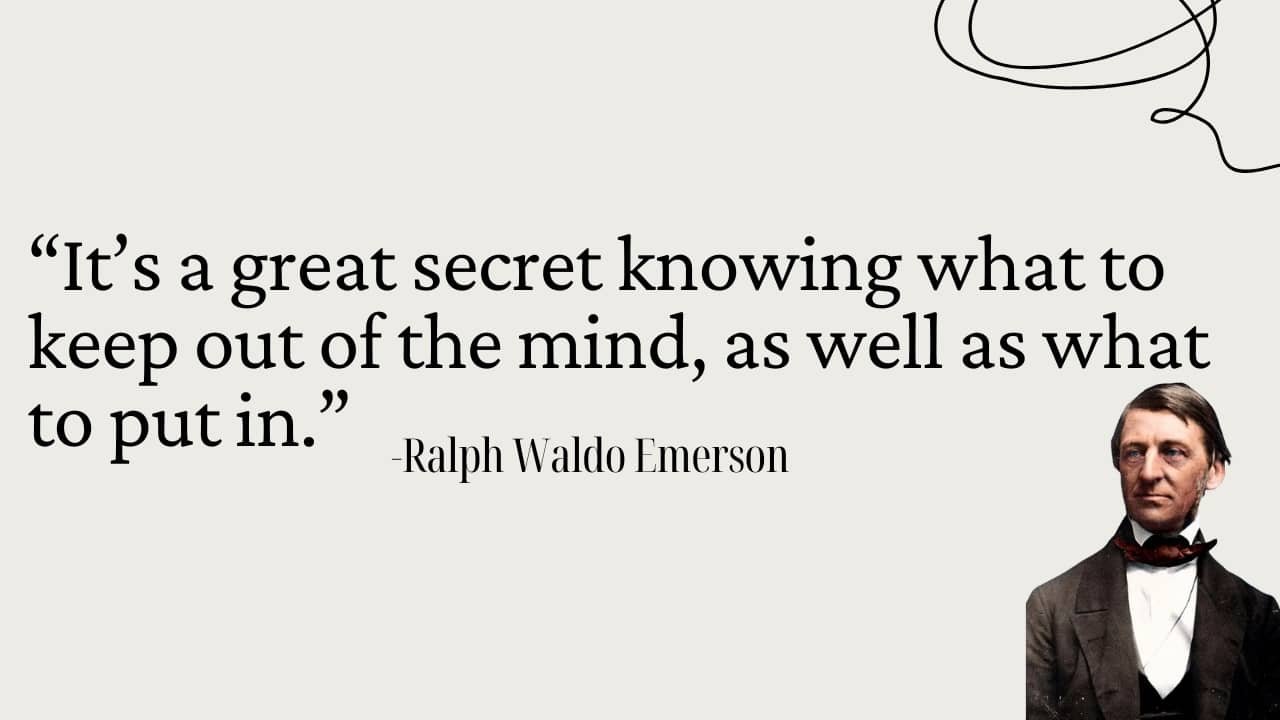
First, let’s get some semantics out of the way. I prefer the term “notebook,” which to me sounds like a working tool for thinking.
However, Emerson referred to them as “journals,” so we’ll stick with his terminology throughout this series–even though “journal” reminds me of my grandmother, who wrote about the weather in her “journal” every day for over thirty years. (We have lots of Utah weather reports. ⛈️)
The Problem with Journals
Here’s the question I’ve been trying to answer my entire life: How do I find the “good stuff” in my journals, and how do I use that stuff to make better stuff?
I’ve got a STUFF problem. I feel like I should reference George Carlin here, but let’s stay focused, people!
Ralph Waldo Emerson is a great model for anyone interested in solving the STUFF problem. “The mature Emerson would look back on his voluminous journals as his savings bank” (Richardson, First We Read 19).
That’s the key phrase this week -> “Savings Bank.”🏦
I’m going to argue that, in order to get the most from our journals, we first need to change HOW we see them.
🦄 For many, a journal is a sacred thing–too pretty to write in. It’s leatherbound, costs $47 at Barnes and Noble, and deserves a high place on the shelf. This kind of journal could never be a savings bank for your ideas—it’s too freaking gorgeous!
👩🏽🎨 For others, a journal is an art project—each page filled with beautiful handwriting, surrounded by floral designs and colored in with Posca markers. The idea is that the more visually appealing your journal is, the more likely you’ll want to spend time in it.
I’ve found the opposite for me—but that’s just me. If I have to worry about style, visual appeal, and color-blending, I’m never going to find the energy to use the damn thing. Sorry for swearing, Mom. I just get so passionate about this stuff!
Every entry would morph into a 4-hour project, and for me, thoughts come quickly. I don’t have time for “pretty” because the next idea, quote, theory, etc., is out there, waiting to be captured and used. I don’t want to miss the good stuff.
Remember our “stuff” problem?
That’s where Emerson comes in.
His journals were an organized mess.
And he filled hundreds of them. In fact, he created “Two enormous 400-page indexes, one built on the other…” (Richardson, Mind on Fire 437).
Can you imagine needing two massive indices just to keep track of all the ideas? We’ll get into indexing starting in week 3. I love a good index, and I think you will too. 🥳
This Week’s Journaling Homework
For this week, begin to see your journal, not as a sacred thing or an art project to pass on to the grandkids, but as a savings bank where you pour forth your soul.
Let it come out in ALL its messy glory. Don’t worry about getting it right, making it pretty, or scuffing the leather. In fact, scuff the leather on purpose!
📝YOUR HOMEWORK: Your only Emersonian job this week is to open a savings bank and start making idea deposits. Don’t worry about organizing them. Go ahead and clump your gardening ideas in with your thoughts about our book club discussions. We’ll handle the organization later. Just write it down as it comes to you.
Want to See an Example? 👇🏻
❤️ I LOVE BYRON’S JOURNAL ❤️
Byron is a friend of mine, and graciously shared a copy of his new journal. Here’s what he taught me:
“An art teacher I had in college said if you’re having trouble beginning a painting or drawing, make a mark inadvertently to ‘violate the paper.’ I kept feeling hesitant about starting this journal; however, I remembered that statement and realized that I just had to do something on the cover to get myself ready to begin again.”
I love his coaching for 3 reasons:
- We avoid using our journals and notebooks for fear of ruining them. Byron overcame that fear by “violating the paper,” making this notebook a safe place to let ideas flow.
- Byron is a VERY talented artist. He could have spent hours painting the perfect cover on this thing. Instead, he grabbed a pencil and let his heart do the talking for a few minutes. He let his subconscious flow, making this notebook a safe place for his subconscious to flow.
- Byron is living an examined life, as Socrates taught us. He’s investigating his true self.
My favorite line from his post is, “I just had to do something on the cover to get myself ready to begin again.” He faced resistance to this project, and knowing that, he made this notebook a safe place to let resistance fade away.
Thanks for sharing, Byron! You’re the man, and you’ve helped me reimagine how I can relate to my own notebooks for a more examined life.
***Next week, I’ll be posting about how Emerson stayed in constant contact with his journals.
👋 Until next week, read slowly – take notes – apply the ideas.
-Eddy

Sometimes, I jot ideas on the back of envelopes or scrap paper. I need a “journal” close by, but if it isn’t, I will write it down on anything made from paper or cardboard. Months, weeks, or days later, I find the little jewels scattered about my life like dust motes lazily landing in the corners of desks, purses, lunch boxes, and pockets.
This is a great post, and I loved the examples of journal pages! I always think it’s fun to see the way others journal, see their handwriting, their writing space, etc. I was momentarily confused when you wrote “Byron’s journal.” My mind went straight to, you know, LORD Byron and I thought that is not his journal. But it did make me think about Lord Byron’s journals and letters and how, if he were alive today, his social media page would be absolutely glorious chaos. 😂