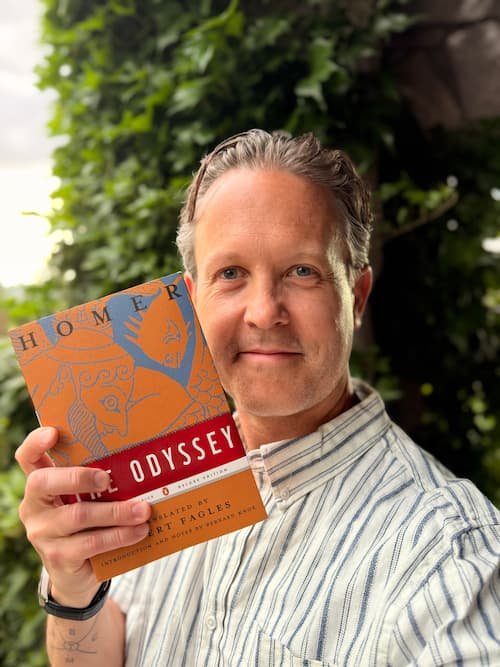
The Odyssey by Homer is for other people to read, right?
English departments read Homer, but not you. After all, it’s epic poetry—and let’s not forget that it’s old. I’m talking 2,700 years old. Wouldn’t it be more fun to read something new?
Maybe.
But here’s the thing: I think you’re going to love The Odyssey. In fact, I’d argue (and I will below) that once you read this book, you’ll unlock a new level of readerly love. You don’t need a degree in Literature or a Ph.D. in Greek Studies. All you need to enjoy The Odyssey is a love for adventure, romance, and impossible odds.
For the more skeptical, there are deeper reasons to spend the next month following Odysseus the resourceful. Let’s dig in.
Have you ever watched a movie full of car chases, explosions, and daring escapes, only to say afterward, “Nothing happened”? That’s because action and plot points alone don’t make an interesting story.
Aristotle knew this and wrote extensively about it in his work Poetics. There, he praised The Odyssey for its remarkable structure because, while many difficult things happen to Odysseus, they all revolve around a central motivation: getting home. Odysseus is trying to return home after the war to be with his wife, Penelope. That desire makes his battles with monsters, the ocean, and even the gods themselves more than just plot points—it makes The Odyssey a story.
Second, The Odyssey by Homer is worth reading because of its rhythm.
The work is written in dactylic hexameter, which is a fancy way of saying that each line is built around six metrical units (feet), often using a rhythmic pattern of one long syllable followed by two short syllables (— ∪ ∪). Much of this musicality is lost in translation from Greek into English, but you can still feel the beauty and movement of the work.
Here are a few lines to give you a sense of what I’m talking about:
- “Sing to me of the man, Muse, the man of twists and turns…”
- “That moment soothing slumber fell from my eyes…”
- “Not a soul escapes his death and doom.”
Finally, The Odyssey is a great way to reclaim your mental space.
Do you want to slow down and read something meaningful? Are you ready to choose your focus rather than let social media and YouTube decide what you think about all day?
The Odyssey is perfectly suited to slower, more thoughtful living. It trains your mind to make connections, appreciate great writing, and gives you something meaningful to talk about around the dinner table tonight.
As a poem, it reminds you of the beauty of language and imagery. As an epic, it keeps you turning pages as Odysseus struggles onward. And as one of the foundational texts of the Western canon, it roots you in one of humanity’s great stories.
Question #1: Will Odysseus finally return home to Penelope?
Question #2: And will she remain faithful to their love?
You’ll have to read it to find out.
As always, read slowly – take notes – apply the ideas.
-Eddy
P.S. – My book club is reading The Odyssey starting May 26, 2026, if you’d like to read it with me.
P.P.S – I prefer the Robert Fagles translation found here.

Good morning. I’m wondering what time your zoom book club meetings are on Tuesdays and if I can choose which free month I would like to join.
Specifically I’d like to join the discussion that starts on July 14 with “Wisdom Takes Work.
Thanks,
Linda
We meet at 6:30 MST / 8:30 EST and all are recoded in case you can’t attend live. The best way to select your free month is to start during that month. I don’t have a feature that lets you choose which month. I hope that helps!
Yes that helps. Thanks.